The Hierophant meaning in a three-card reading
In this deck, The Hierophant means tradition. Upright, it asks you to learn from a tested practice. Reversed, it asks you to question a rule followed only from habit.
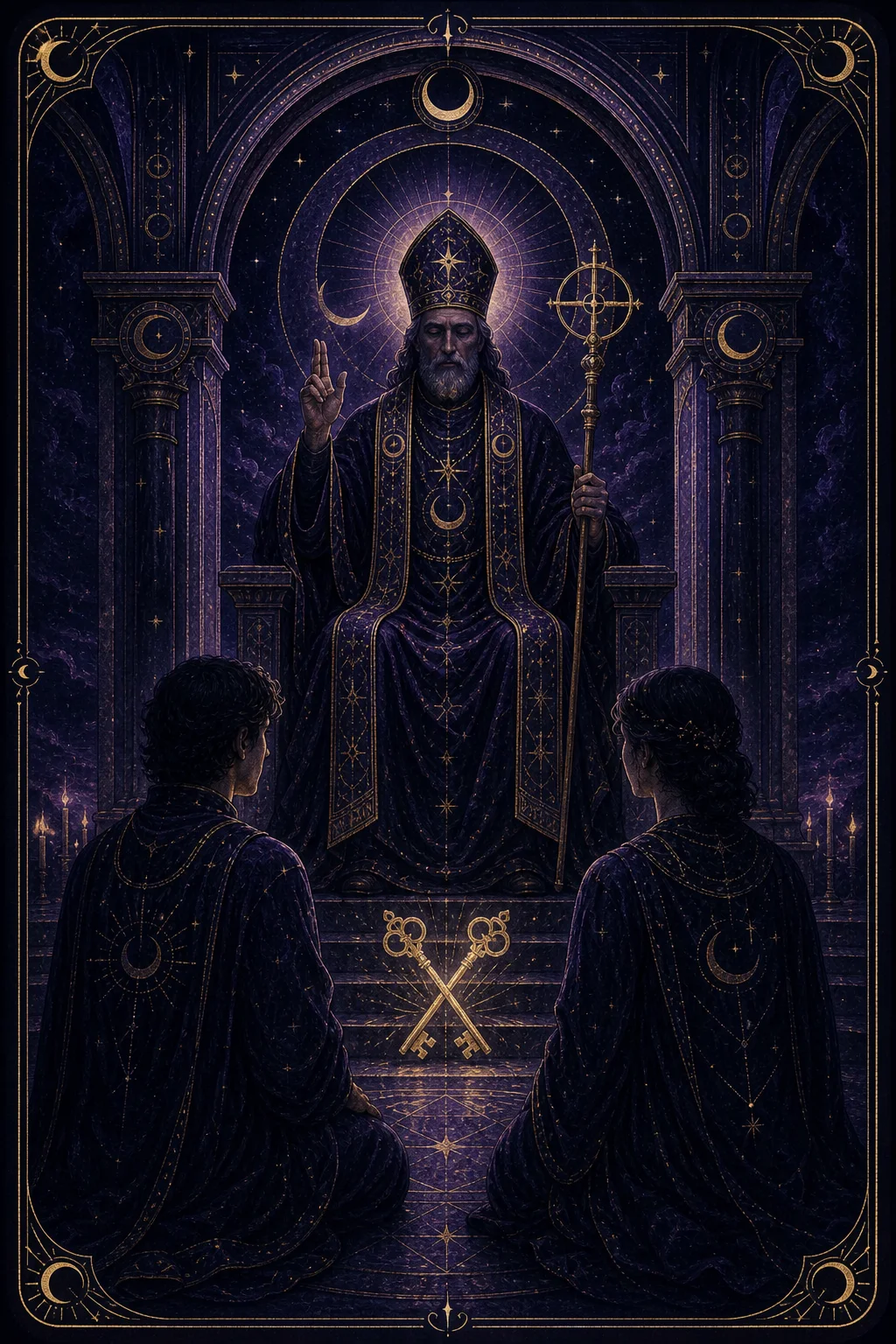
What the picture shows
This illustration shows a robed figure in a tall mitre seated on a raised throne between carved arches. One hand is lifted in a gesture of teaching, and the other holds a staff topped with a ringed cross. Two figures kneel on the steps with their backs to us, and a pair of golden keys lies crossed in front of them.
In the Rider–Waite–Smith tradition the Hierophant, once called the Pope, sits between two pillars and instructs two followers, and crossed keys appear at the base. The keys are usually read as access to knowledge that has been handed on rather than invented. The raised hand is a teaching gesture. Notice that the kneeling figures face away from us, so the viewer stands where a newcomer might stand.
Upright in practice
Upright, the Hierophant recommends learning from a tested practice. Instead of inventing everything from scratch, it suggests that someone has already worked on your problem and left a method you can borrow. That could be a trade, a tradition, a mentor or a set of habits that has held up over time. The card values the unglamorous work of apprenticeship. Ask which established method you have been avoiding because it felt too ordinary, and what you could gain from practising it exactly as taught before you adapt it. Adaptation comes more easily after you know what you are adapting.
Reversed in practice
Reversed, the Hierophant questions a rule followed only from habit. The picture shows a tradition being passed on, and the reversed card asks whether you ever agreed to it. This deck treats that as a change of emphasis rather than a rejection. Some inherited practices are worth keeping once you have examined them, and some are simply old. Look at the habits, expectations and obligations you carry from family, work or community, and sort them into those you would choose again and those you would not. The sorting itself is the useful work.
Three questions to carry
- Which established method have I been skipping?
- What have I accepted without ever deciding to accept it?
- Who could teach me this, and have I asked?
Beside its neighbours
The Hierophant follows the Emperor and precedes the Lovers. Where the Emperor builds personal structure, the Hierophant presents structure shared with others. The next card, the Lovers, turns to a choice made from your own values. Read together, the three cards often ask what you inherited, what you decided and what you still need to choose. Beside the Lovers, the Hierophant can mark the difference between a tradition you were given and a commitment you make.