The Empress meaning in a three-card reading
In this deck, The Empress means nourishment. Upright, it asks you to make room for growth and care. Reversed, it asks you to check whether care has become overextension.
What the picture shows
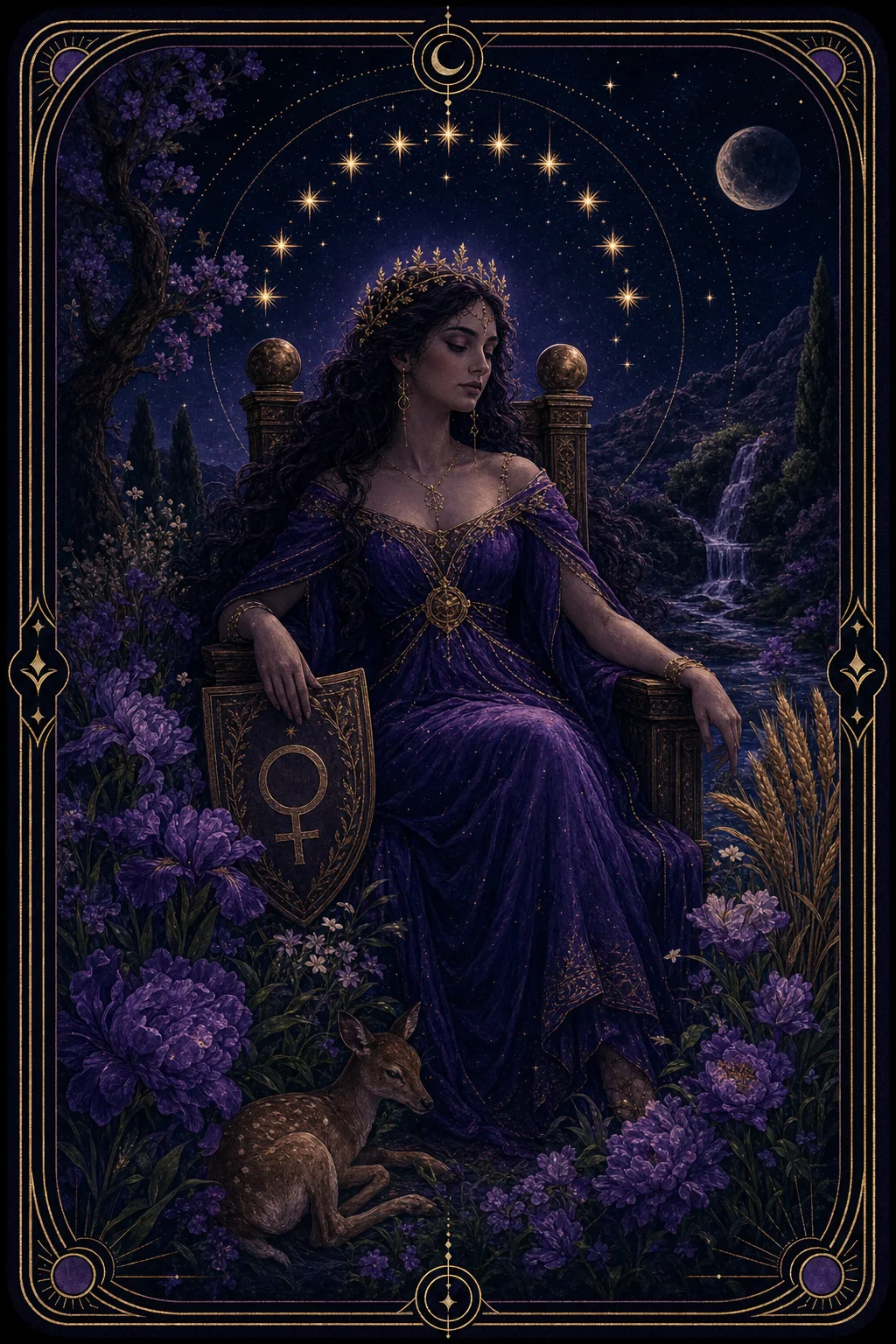
This illustration shows a crowned woman seated on a throne in the middle of a garden. A shield bearing the symbol for Venus rests against her chair, and an arch of small stars curves above her head. Purple flowers crowd the lower edge, golden wheat stands at the right and a young deer lies curled near her feet.
In the Rider–Waite–Smith tradition the Empress is surrounded by growing things, and the Venus symbol ties her to love and abundance. A waterfall in the background keeps the landscape in motion. The twelve-star crown or arch is a common feature of the card. Notice that nothing in the picture is hurried. Everything is in leaf, flower or fruit, and the figure is resting rather than working, which is part of the point.
Upright in practice
Upright, the Empress is the card of nourishment. It asks where growth needs room, and what kind of care would help rather than hover. That might be a creative project that needs regular unpressured time, a friendship that needs a plain invitation, or a body that needs rest more than correction. The card values steady, generous conditions over dramatic effort. A useful question is what you would provide for something you love, and whether you would provide it for yourself. Notice also what you are tending out of habit that no longer grows.
Reversed in practice
Reversed, the Empress asks you to check whether care has become overextension. The comfortable garden in the picture needs a gardener who is also fed. In this deck the shift is gentle. Look for a place where giving has turned into managing. Look also for where looking after others has quietly replaced your own needs. The card can also describe the opposite, a stretch of neglect where a thing you value has gone without attention. In both cases the practical step is small, and it begins with an honest account of your own capacity.
Three questions to carry
- What in my life needs room more than it needs fixing?
- Where has my care become control or exhaustion?
- What would I offer myself if I treated my needs as worth feeding?
Beside its neighbours
The Empress sits between the High Priestess and the Emperor. Her theme is nourishment, and her neighbours bring two kinds of boundary: the Priestess's quiet interior one and the Emperor's firm external one. Beside the Emperor, the Empress often reads as warmth and structure working together, a garden with a fence. Beside the High Priestess, the pair suggests that what you sense and what you tend belong in the same conversation.