The Emperor meaning in a three-card reading
In this deck, The Emperor means structure. Upright, it asks you to give the situation a firm container. Reversed, it asks you to soften a rule that has become rigid.
What the picture shows
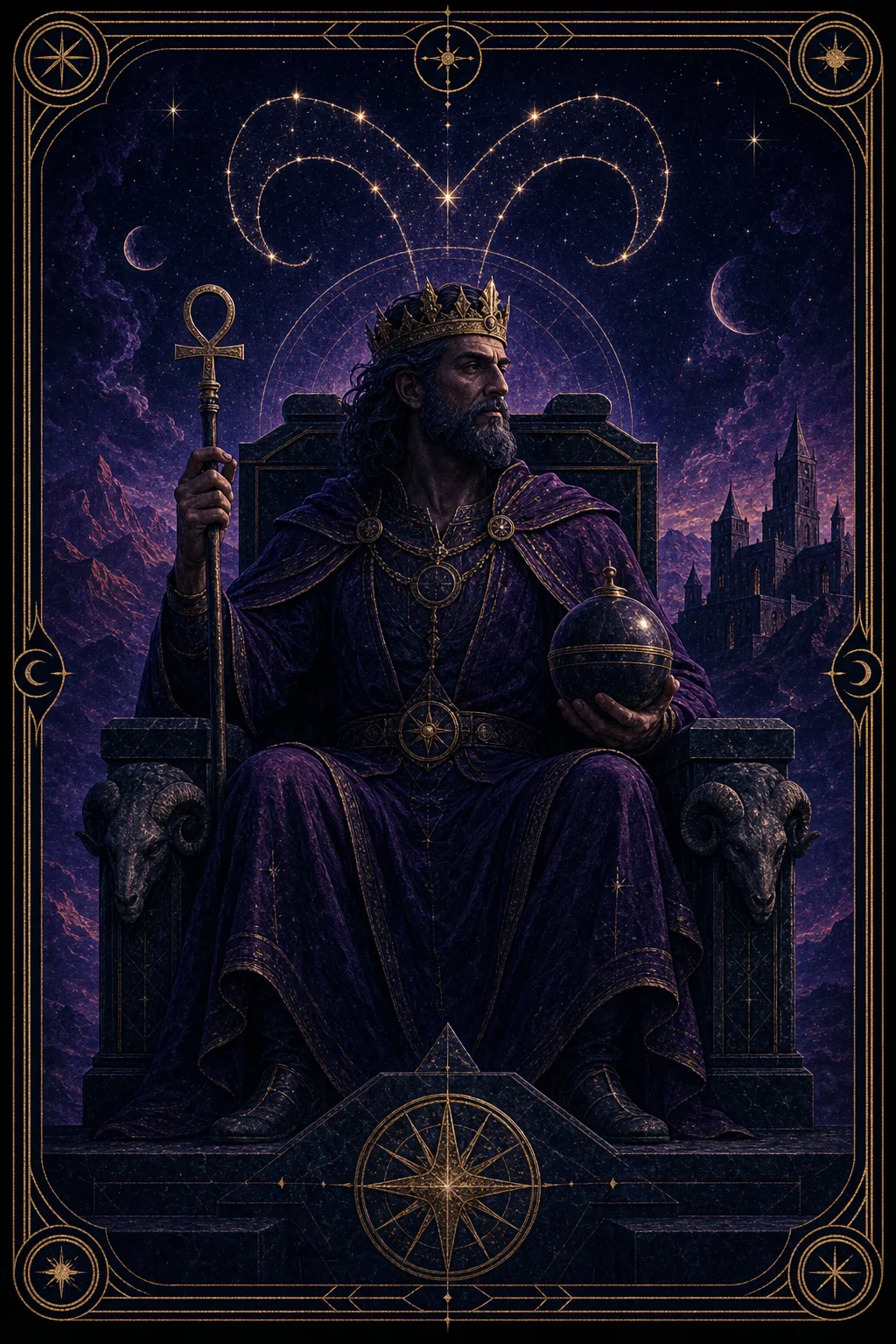
This illustration shows a bearded, crowned man on a heavy stone throne whose arms end in carved ram heads. He holds an ankh-topped sceptre in one hand and a dark orb in the other. A golden compass-like star is set into the steps at his feet, and a castle rises against purple mountains behind him.
In the Rider–Waite–Smith tradition the Emperor is a seated ruler, and the ram's heads connect him with the sign Aries. The orb and sceptre are the standard emblems of governance. The compass-style star in this deck is not part of the traditional layout. It reads naturally as orientation, which suits the card's theme of structure. Nothing in the picture is flexible, and that is the card's emphasis.
Upright in practice
Upright, the Emperor offers a firm container for the situation. When a plan keeps sliding, a clear rule, schedule or boundary can do more than another burst of enthusiasm. The card is not about domination. It is about deciding what the structure is for and then keeping to it. Think about a project that lacks a deadline, a relationship that lacks an agreed limit or a week that lacks any fixed point. Choose one simple, visible rule and test it for a while. Good structure should make the work easier to carry, and you can adjust it if it does not.
Reversed in practice
Reversed, the Emperor asks you to soften a rule that has become rigid. The throne in the picture is solid, but a rule that served a purpose can outlast that purpose. In this deck the emphasis is on loosening, not abandoning. Ask which of your standards you would still choose today, and which you keep because changing them feels like losing face. The card can also describe the opposite problem, where nobody has made the decision and everyone is waiting. Either way, the useful move is to state the rule aloud and see whether it still earns its place.
Three questions to carry
- What structure would make this situation easier to carry?
- Which of my rules do I follow only because I always have?
- Who is waiting for a decision that I could simply make?
Beside its neighbours
The Emperor follows the Empress and precedes the Hierophant. After the Empress's open-handed care, he sets limits. Before the Hierophant, he is the personal version of order, where the next card is the shared version, handed down through institutions and teachers. Beside the Empress, structure and warmth balance one another. Beside the Hierophant, the pair can ask whether the rules you hold are ones you chose or ones you inherited.