The Chariot meaning in a three-card reading
In this deck, The Chariot means direction. Upright, it asks you to gather competing impulses behind one aim. Reversed, it asks you to slow momentum that has lost its direction.
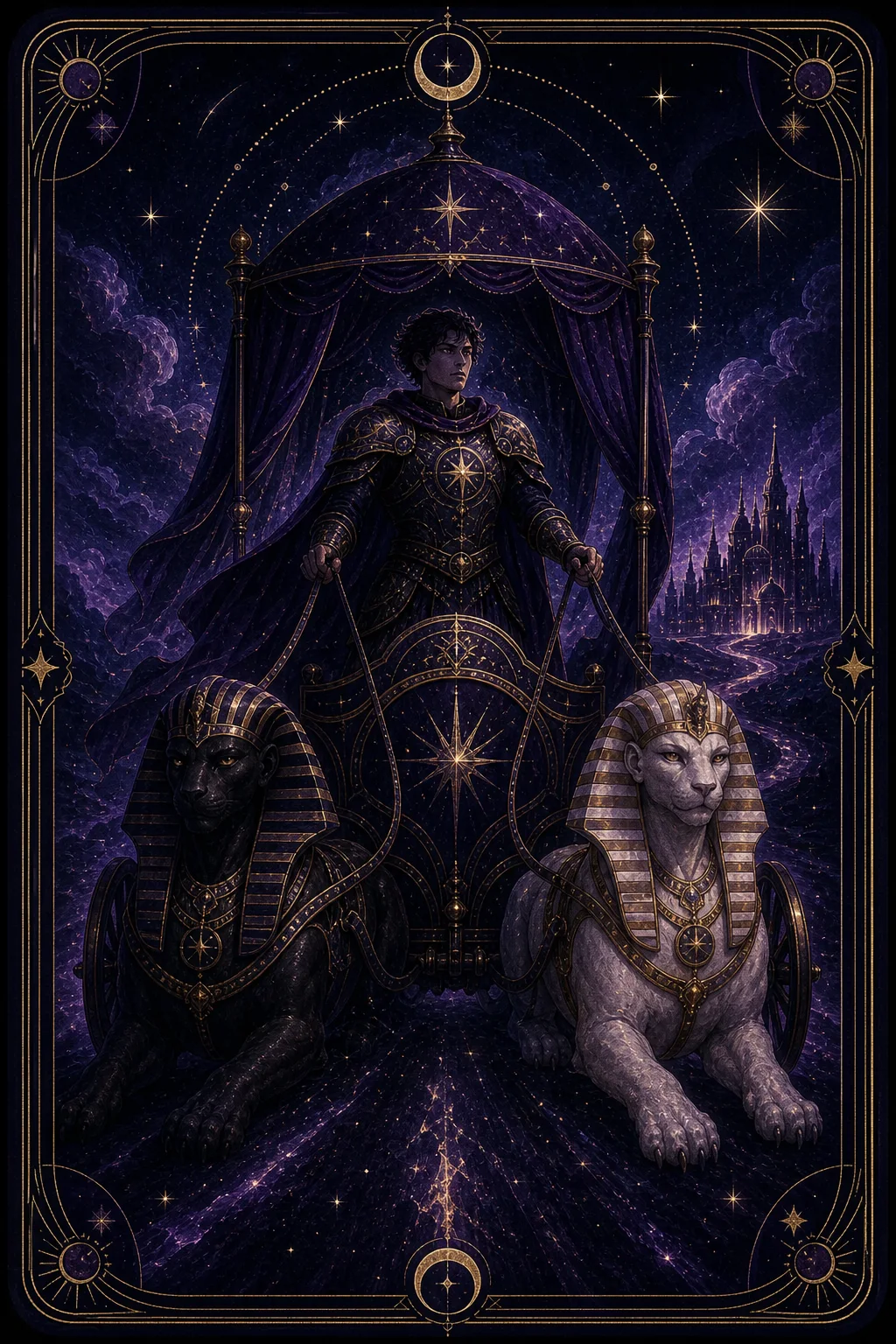
What the picture shows
This illustration shows an armoured figure standing under a star-studded canopy on a chariot, reins gathered in both hands. In front of the vehicle two sphinx-like creatures rest, one black and one pale, each wearing a striped headdress. A glowing walled city lies in the distance, and a path of lights runs toward the viewer.
In the Rider–Waite–Smith tradition the Chariot is drawn by two sphinxes, one dark and one light, beneath a canopy of stars. The pairing is usually read as opposing forces that have to be steered rather than silenced. In this deck the driver visibly holds reins, so the effort of steering stays in view. The canopy of stars above the driver makes the achievement look like discipline more than speed.
Upright in practice
Upright, the Chariot is about gathering competing impulses behind one aim. Nearly everyone has two or three wants that pull against each other, such as ambition and rest or caution and curiosity. The card does not ask you to defeat any of them. It asks for a direction clear enough that each can be turned to a shared use. Name the single aim for the next stretch of time. Then see which of your impulses help and which merely compete. A stated aim shapes small decisions long before it shapes large ones.
Reversed in practice
Reversed, the Chariot asks you to slow momentum that has lost its direction. In this deck the emphasis is on the word direction. Sustained effort can feel productive while quietly heading nowhere in particular, and speed can disguise that. Check the destination first. If it is still the right one, ask what pulls the two creatures apart and what would bring them back into step. If it is not, a brief stop is not a failure. It may be the most useful thing the driver can do before the next stretch.
Three questions to carry
- What single aim should the next few weeks serve?
- Which of my competing impulses is actually pulling me off course?
- Is this speed taking me somewhere I still want to go?
Beside its neighbours
The Chariot follows the Lovers and precedes Strength. Where the Lovers asks what you value, the Chariot gives that value a direction. Strength, which comes next, offers a different method: patience in place of force. If the Chariot and Strength appear in the same spread, they invite a comparison. One pushes through, the other persists gently. Ask which the situation really needs.