Death meaning in a three-card reading
In this deck, Death means transition. Upright, it asks you to let an ended form make space for the next. Reversed, it asks you to stop negotiating with a change already here.
What the picture shows
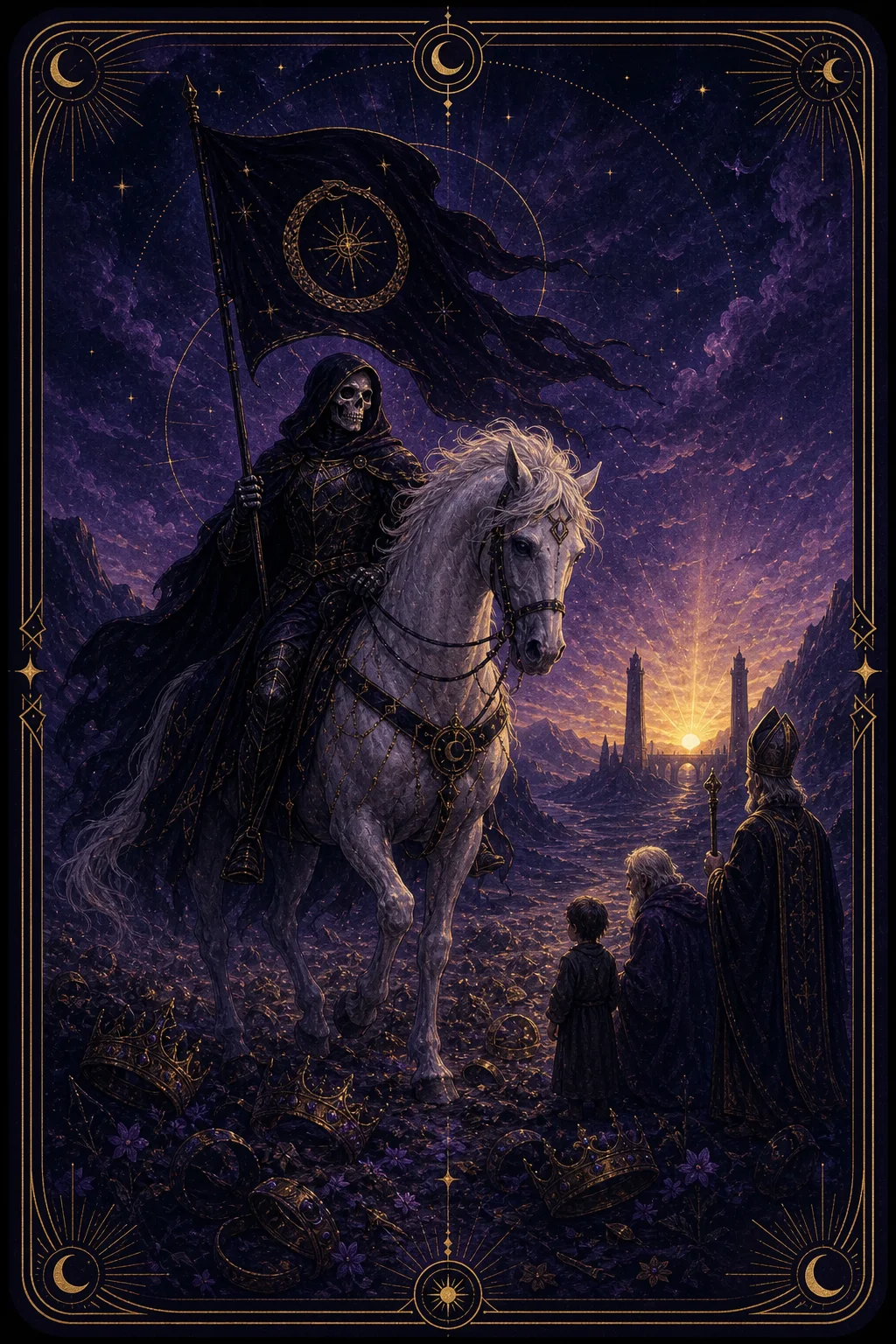
This illustration shows a skeletal rider on a pale horse carrying a tall dark banner marked with a circular, star-like emblem. A glow rises between two distant towers at the horizon. In front of the horse a child, a kneeling figure and a mitred figure stand in a line, and several gold crowns lie scattered on the ground.
In the Rider–Waite–Smith tradition Death rides a white horse and carries a black flag, and the figures before him include a bishop, a child and others. The sun rising between two towers is also a traditional detail. Readers usually take the card as a symbol of ending and transformation, not literal death. The rider is not hurrying, and the landscape behind him is lit. The crowns on the ground suggest that titles and status do not alter that.
Upright in practice
Upright, Death is the card of an ending that makes space for the next stage. It is not about physical death. It describes a job, a role, a habit, a belief or a season of life that has run its course. The card suggests letting the ended form go instead of clinging to it. Grief and relief can both belong here. Ask what has already finished in practice even though you have not yet admitted it, and what small, concrete step would honour that finish. Often the space an ending leaves is the first thing worth examining.
Reversed in practice
Reversed, Death asks you to stop negotiating with a change already here. In this deck the emphasis falls on the bargaining. You may be repeating a conversation, hoping the situation will revert, or keeping a role going out of loyalty to the person you used to be. The card does not push you to act abruptly. It invites you to describe the change in plain terms and say it aloud to someone you trust. Then ask what you would do differently if you accepted it as settled. Acceptance often makes the next decision easier to see.
Three questions to carry
- What has already ended in practice that I have not named?
- What am I still bargaining over after the answer has become clear?
- What does the space left behind make possible?
Beside its neighbours
Death follows the Hanged One and precedes Temperance. After the suspended pause of the Hanged One, it marks the point at which something is released. Before Temperance, it clears the way for a slower task: blending what remains into something workable. Beside Temperance, Death can describe a period of ending followed by patient adjustment. Beside the Hanged One, it suggests that the waiting was preparation for letting go.